There is much talk in the shooting world and beyond about 'deer management', but what does that actually entail, why is it important, and what kit should you use for the job?
I've been a game shot since I was able to hold a gun, but despite having grown up on a farm in Hampshire overrun with roe deer, until a few weeks ago I had never once been stalking or shot anything larger than a rabbit with a rifle. However, I recently went on my first (unsuccessful) stalking trip and am keen to find out more about deer management, perhaps with a view to reducing some of the deer on the farm back home. With this in mind I spoke to professional deer manager Tom Cackett of Oxon Deer to understand a bit more about it.
George Browne: Tell me a bit about Oxon Deer and what you do?
Tom Cackett: Oxon Deer Limited has been running in various guises since 2016, but we didn't incorporate it into a Limited Company until 2018. Originally it was setup almost as a syndicate, a way of holding stalking leases. But not long after I created it requests started coming in from people wanting deer management, or even advice on different aspects of deer management. As a company we deliver deer management services, and also professional services such as population surveys, impact assessments, cull plans, and so on.
GB: How much ground do you manage, and how many of you are there?
TC: I always lose count of how much ground we manage, but it is now close to 3,000 acres split across various different farms. There are only two of us - the vast majority of our work is done by myself, but I do draft in the services of a trusted friend to help with peak periods such as the doe cull between November and March.
GB: Can you explain why deer management is so important - what would the impact of no deer control be on the ground you manage?
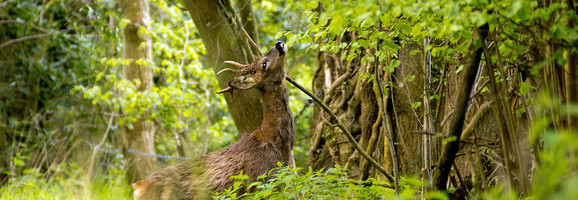
TC: In the UK we are in an usual but incredibly privileged position - we have six species of wild deer roaming around the countryside. Only two are truly native (Red and Roe), although you could argue Fallow are now native too, but we won't go into that. So not only is our ecosystem having to cope with a higher number of deer species than it was designed for, but deer have no predators in the UK. So, without people controlling deer numbers there would be nothing keeping them in check. I usually receive phone calls from foresters, farmers and land owners because, whilst they love seeing deer on their land, they have started to see a deterioration in the habitats they are managing. This could be a lack of understorey within woodlands, damage to young trees, or heavy grazing pressure on crops. We therefore try to mitigate this damage by keeping deer numbers at a sensible level.
GB: Are there any particular examples of ground you've started managing that has been damaged by deer, and you've been able to reverse that damage?
TC: One of the areas I'm most proud of is a small block of woodland near Nuffield in Oxfordshire. When we first arrived, the woodland was heaving with Fallow deer - I couldn't believe my eyes when I first arrived. The Fallow had grazed off everything apart from the mature trees. The browse line was so obvious it looked like someone had pruned all of the trees into topiary! It's taken us three years, but we've now started to get on top of the Fallow deer and you can start to see a diverse green understorey in the woodland again. An added bonus has also been that Roe deer have returned to the woodland - before the competition for food had been so high that we didn't see any Roe at all.
GB: How do you select a deer to cull? What sort of thing are you looking for?
TC: It largely depends on the species. However, if you are looking to reduce numbers then it is the female deer you are targeting as they are the ones that reproduce. That probably sounds silly, but it only takes one male deer to impregnate multiple female deer, whereas for every female deer you remove you've lessened the number of fawns that will be born. Generally, you are looking to remove any animals with deformities, or ones that stand out as being smaller or weaker than the rest. Someone once referred to it as 'farming from afar', and I think that is a very good saying - you are looking to retain the best animals for breeding and remove the ones whose genes you don't want passed on.
GB: How do you know how many deer you need to cull from any given estate or herd?
TC: We usually conduct two surveys - one is a population survey, and the other is a habitat survey. These two surveys should tell us how many deer are present, and how much of an impact they are having on the area they are living in. If the deer are having a big detrimental impact on the habitat then we know we need to reduce numbers to a manageable level. We'll then cross reference this with the population survey to help decide how many animals we want to remove and from which category, i.e. age and sex.
GB: Why do you choose to use non-lead ammunition?
TC: Venison is incredibly healthy, tasty and has brilliant green credentials. The last thing I want is for someone to choose not to eat it because they feel it has been contaminated by a lead bullet. The use of lead water pipes was outlawed in England in 1969 / 1970 because lead was known to have detrimental consequences when consumed. To my mind there is no reason why the venison industry shouldn't follow best practice.
GB: What happens to the venison you shoot?
TC: Every last bit is eaten! Some is taken to local pubs, restaurants and butchers, the rest is either taken to our local game dealer, or taken home by me to be fed to family and friends.
GB: What kit do you use and why?
GB: Buy once, cry once is a motto I live by. I've bought cheap equipment before, and without fail it has let me down. My main rifle is a Tikka T3X in .308. Tikka aren't top end rifles, but they have a reputation of working flawlessly whilst also being bomb proof. I'm always impressed at how accurate it is too. The Tikka has a Zeiss scope on top of it which probably cost more than the rifle itself, but it gives me the confidence to take longer range shots, or when the light isn't brilliant.
All of my clothing is Harkila. It is only when you wear an item of Harkila clothing that you realise what sets it apart from its competitors - it's very well made, and has clearly been designed by fellow hunters so has all the features you'd want from top end clothing. Furthermore, it's very adaptable and doesn't look out of place on a peg shooting pheasants, in the woods stalking deer, or even walking down the high-street!
Tom Cackett is a Harkila ambassador. To find out more about Harkila's range of technical stalking apparell and accessories, visit their website.


Comments
Loading comments…
Post a comment
to post a comment.