
Each year the Game Shooting Census, carried out by GunsOnPegs and sponsored by Lycetts, gathers data from thousands of guns and hundreds of shoots of all sizes and kinds to paint an ongoing picture of the shooting world. The 2023 surveys were no different; shoots of all types and sizes took part, from large scale commercial operations to private farm shoots and everything in between, as well as guns of all stripes.

One of the fascinating results to come out of the Shoot Owner Census is that 43% of shoots are run primarily as syndicates. However, even knowing this it may surprise many to learn that according to the 2023 data, only 11% of shoots are run to make a profit, while 40% look to wash their face, and a further 18% look to subsidise private or syndicate shooting by selling a few days here and there.
Around 25% say that their shoot is run entirely for fun, and the financials aren’t relevant. Even if you filter out the shoots that don't sell any days, only 20% of shoots that actually do sell days are looking to make a profit.
How is game shooting in the UK priced?
When it comes to how much shoots charge their guests, there is significant variance. If you are new to shooting, the pricing can be a bit opaque. As a general rule, shoots offer prices “per bird”.
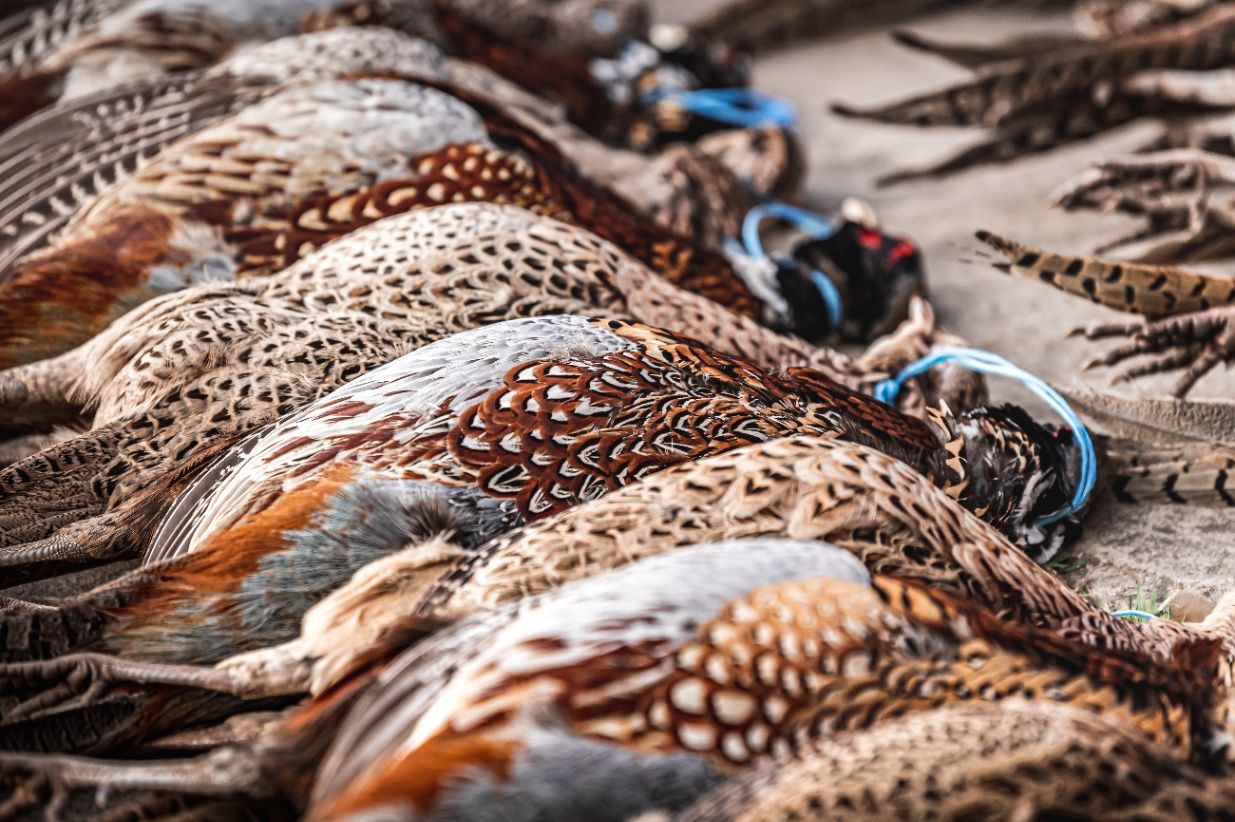
Consequently, to work out how much any given day will cost you, and assuming that VAT is not chargeable, one multiplies the expected number of shot birds shot by the price per bird. This gives you the total cost of the day.
Total cost of the day = [bag size] x [£/bird]
To find out the cost per person or peg, simply divide that total cost by the number of guns in the team:
Cost per person/peg = { [bag size] x [£/bird] } ÷ [number of guns]
So what are the costs involved in running a shoot?
This is a commonly asked question. Running a shoot day takes a great deal of effort and input, and the "price per bird" reflects an entire year's work, not just the running of a shoot day. Even if a shoot isn’t seeking to make a profit, the price must cover a number of costs, including but not limited to:
- The gamekeeper's and other shoot employees' salaries
- Rent of sporting rights and cover crop areas
- Cover crop planting and management
- Conservation work
- The birds themselves and their feed
- Vet's bills and other running costs
- Marketing expenses
- Pay for beaters' and pickers up pay
- Shoot day hospitality and catering
How much does shooting cost in 2023?
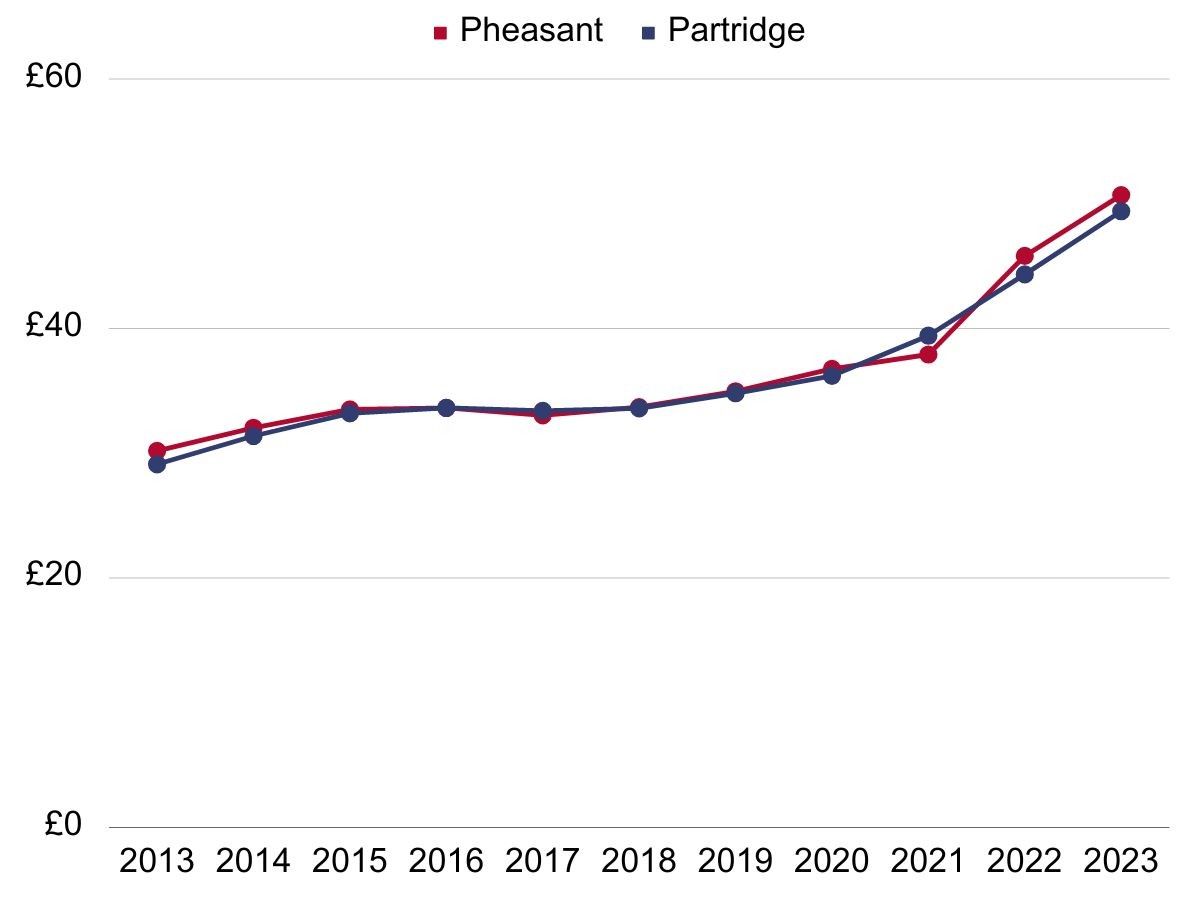
The cost of shooting has increased sharply over the last decade. The first Game Shooting Census was carried out in 2013. Back then, the average cost of a shot pheasant was £30.17, and a partridge was £29.09.
The 2023 Game Shooting Census reveals that the average price of a pheasant on the game cart in 2023/24 is £50.69, and a partridge costs £49.40. The graph below shows how the cost of shooting has changed over the last ten years
Why has shooting become more expensive?
As you can see, the cost of shooting has dramatically increased in the last decade, but why? Is it simply inflation?
Well, no. If we were only looking at an inflationary rise, the cost of a pheasant in 2023 should be £39.98, and a partridge should be £38.65, an increase of 33%. What we have actually seen is an increase of 68%, so more than double the rate of inflation over that time.
Poult prices
Over the last few seasons, the cost of shooting has been driven up by huge increases in the input costs of running a shoot, particularly the birds themselves, and their feed.
One of the biggest input costs for any shoot is the cost of stocking their shoot. Most shoots stock their shoot with poults. In 2013 shoots paid an average of £3.47 for a pheasant poult, and £3.84 for a partridge poult.

Since then the price of a pheasant poult has increased by more than 75%, to £5.99, while partridge poults are 90% more expensive at £7.30 per poult.
If we take the increase in input costs from the birds alone then (£2.40 per pheasant poult) then we find ourselves with a £7.20 increase in the cost per shot bird. The average shoot has a return of about 33%, meaning that for every bird that is shot over the course of the season, a shoot will need to release three poults, so any increase in the cost of a poult has a 3x impact on the cost of a shot bird. This impact is even greater for shoots that have a lower return, in particular high bird shoots.
The impact of bird flu on the cost of shooting
Last season’s outbreak of Avian Influenza in the major game farming regions of France, where a significant proportion of all the UK stock originates, was the main catalyst for last season’s jump in poult prices.

Movement bans on poultry products, including game bird eggs, chicks and poults, that lasted up until the start of June meant that supplies of red leg partridges were more or less wiped out, while the supply of pheasants was also reduced significantly. As a result demand far outstripped supply and the laws of economics took hold, resulting in a dramatic rise in the cost of eggs, chicks and poults.
This rearing season, although many shoots decided to start up or expand their own rearing operations, the prices charged by game farms have remained high, especially for those shoots that bought and paid for their birds early in order to be confident that they would get their birds.

In a series of articles published on our sister site, ShootHub, in January this year, George Davis, head of the Game Farmers Association, explained that after several tough years, game farmers are now looking to shore up their businesses against the triple-threats of adverse weather, disease and politics. He wrote:
In recent years all three have become more challenging. Game farmers are generally recognising the need to mitigate these, which of course requires more margin. The big question is: what is the sweet spot that is needed, and still affordable for our customers?
Some are suggesting game farmers are asking for too much, which ultimately could push out some guns out of the market. I completely recognise this sentiment, but the cost of shooting is not solely down to the price of a poult, and it is not down to us as game farmers to maintain cheap shooting.
Continual reduction of incentive is a one way street, a house of cards. We can only support the future of shooting with good investment and you cannot maintain that on a shoestring. A financially robust shoot and game farm will make for a more secure future for shooting for the next generation, we have some work to do on that front. Where are the young people going to come from if there is not enough incentive?
The cost of feed
George is correct when he says that the price of a poult is not the only thing that impacts the cost of shooting. Another significant factor is the cost of feeding those birds to ensure that they are fit and strong when the 1st of October rolls around.
The price of game feed is impacted by global events. The war in Ukraine has driven the cost of many agricultural products through the roof, while, as Tom Welham of game feed supplier Marsdens explained last summer, even those not directly impacted by the war are subject to the laws of supply and demand on a global scale:
Other Raw Materials not directly impacted by conflict have, nonetheless, seen enormous increases in prices. Soya was been hit by adverse weather events in South America and the surge in oil prices also directly impacts a range of commodity prices.
While the cost of the raw materials for game bird feed have started to come down, these price drops have not yet filtered through to the prices paid by shoots, as the feed mills must purchase their stocks of wheat, soya etc well in advance.
The reality is that shoots have to pass these costs on to guns, even if they are only seeking to break even, hence the higher prices we have seen over the last couple of seasons.

How much does the average shoot day cost in 2023?
Data from the 2023 Game Shooting Census reveals that the average bag that guns shoot is 119 birds.
We can therefore extrapolate that an average day shooting pheasants, for a team of 8 guns, costs £6,032.11 (plus VAT where applicable), or £754.01 per peg. The same day in the 2022/23 season would have cost £5,451, or £681.42 per peg.
What does this all mean?
The price of shooting, coupled with increases in the cost of living and the poor economic outlook, has increased to such an extent that guns are holding back a little on booking their days. The Game Shooting Census reveals that guns have only booked about 2/3 of the days that they plan to shoot, so with shoots’ diaries looking less full than they normally would at this stage, might we see some better value shooting come onto the market as the season approaches?
We are already seeing a reduction in the price of poults, due to a surge in the supply of poults available brought about shoots and game farms increasing their breeding programmes, so there are positive signs on that front. Feed prices are also falling, as the global markets adjust and new harvest seasons improve the supply of vital commodities.
Where will we be next year?
The fact that the increase in price for a shot bird in 2023 is in line with inflation (10%) and that the supply of game bird eggs, poults and chicks appears to be stabilising should be cause for optimism. There is some evidence to suggest the input cost increases could continue to stabilise and we might end up with a bit of a plateau to prices.
We think it’s fair to say that the vast majority of shoots are not out to make a quick buck, but that they do need to be able to wash their face, or the hard work that goes into putting on the days that we enjoy in the field becomes less and less worth the owners’ while.
With everyone’s budgets squeezed, it may be that in order to ensure that shooting comes through the current economic situation relatively unscathed, we all need to take it on the chin, or reduce the number of days or the size of the bags that we shoot, to keep those shoots operating for when times are easier.
In the mean time, if you are looking for the best value shooting, GunsOnPegs Premium gives members access to shoot day discounts, some running into the hundreds of pounds per peg, and represents a great way to stretch your shooting budget that little bit further.
Comments
Loading comments…
Post a comment
to post a comment.