
It is around six years since Sir Jim Ratcliffe settled in at a West London pub with a couple of mates and conceived of a no-nonsense, stripped back off-road vehicle that would take the S out of SUV and fill the gap he saw in the market.
The Grenadier, named after that London pub, has been hotly anticipated, especially by those who live, work and play in the countryside. Last year, GunsOnPegs were among the first to ever be allowed behind the wheel of a Grenadier, when we took a prototype on a roadtrip to explore some of the UK's myriad fieldsports opportunities and the conservation impacts thereof.
Now, motoring journalists from around the world have had their chance to road test the Grenadier and offer up their verdicts. We've read and watched as many of their reviews as possible, and have pulled out some of their insights.

How does the INEOS Grenadier perform off-road?
The team behind the Grenadier have been very clear that the vehicle has been designed from an off-road first perspective - that's its primary function, its raison d'etre. So, what do the experts make of the vehicle's performance off-road? I think it is fair to say that they were impressed.
Andrew English, The Telegraph's motoring correspondent, was among the journalists invited by INEOS to Scotland to put the Grenadier through its paces. He wrote:
As soon as we turned off the road onto the ethereally beautiful Ardverikie Estate, the Grenadier felt at home, stable, its wheels dug into the light snowy surface and never less than a stout place to be. That initially soft suspension response keeps things calm but not tippy. Excellent wheel articulation keeps the tyres in contact through the most cross-axling terrain and the lugged tyres grip like a speed climber’s fingers. In either petrol or diesel form there’s plenty of low-down power and superb accelerator response and the whole car “walks” along a rough track with the best.

Jason Barlow of topgear.com was also impressed:
As you’d expect, it’s hugely capable off-road, whether it’s rock crawling (though we didn’t do much of that), wading (up to a depth of 800mm), or crossing undulating terrain. Once in off-road mode, the seat belt reminders, parking sensors and the engine start/stop are all switched off. There’s a Downhill Assist and an Uphill Assist function.
Adam Gray, writing for the SupercarBlondie website concurs:
Heading off the beaten track, the Grenadier’s progressive-rate Eibach spring and Bilstein damper set-up is compliant over large bumps. Coupled with impressive wheel articulation from the live axles, it really gives you the sense that the car is maximizing grip from all four tires. It was hard to find terrain tricky enough to stop the Grenadier in its tracks, as it continually seems to find remarkable traction over even the most challenging sections. Ok, there was the odd steep slope that slowed us down, but with a touch more commitment, it managed to scramble up the trickiest of inclines. Heading downhill didn’t seem to phase it much either. Shifting the manual gearbox control, selecting first gear, and using engine braking with both feet off the pedals, the car crawled along pretty safely without losing grip. Thanks to approach and departure angles of 35.5 and 36.1 degrees respectively, the bodywork doesn’t catch the when it meets flat ground, too.
Jonny Smith of the YouTube channel The Late Brake Show appreciated the care that has gone into ensuring the vehicle is well suited to a life lived at the tough end, commenting in his video review:
All the bits that could get easily scuffed or knocked off - mirrors, bumper corners, stuff like that - they're not expensive, they're not made of expensive materials. I like that about it. It has been well thought through. This is a car that's born for adventure. It is sort of utility first, whereas modern Land Rovers, I think have gone too deep into the luxe and the aesthetics.
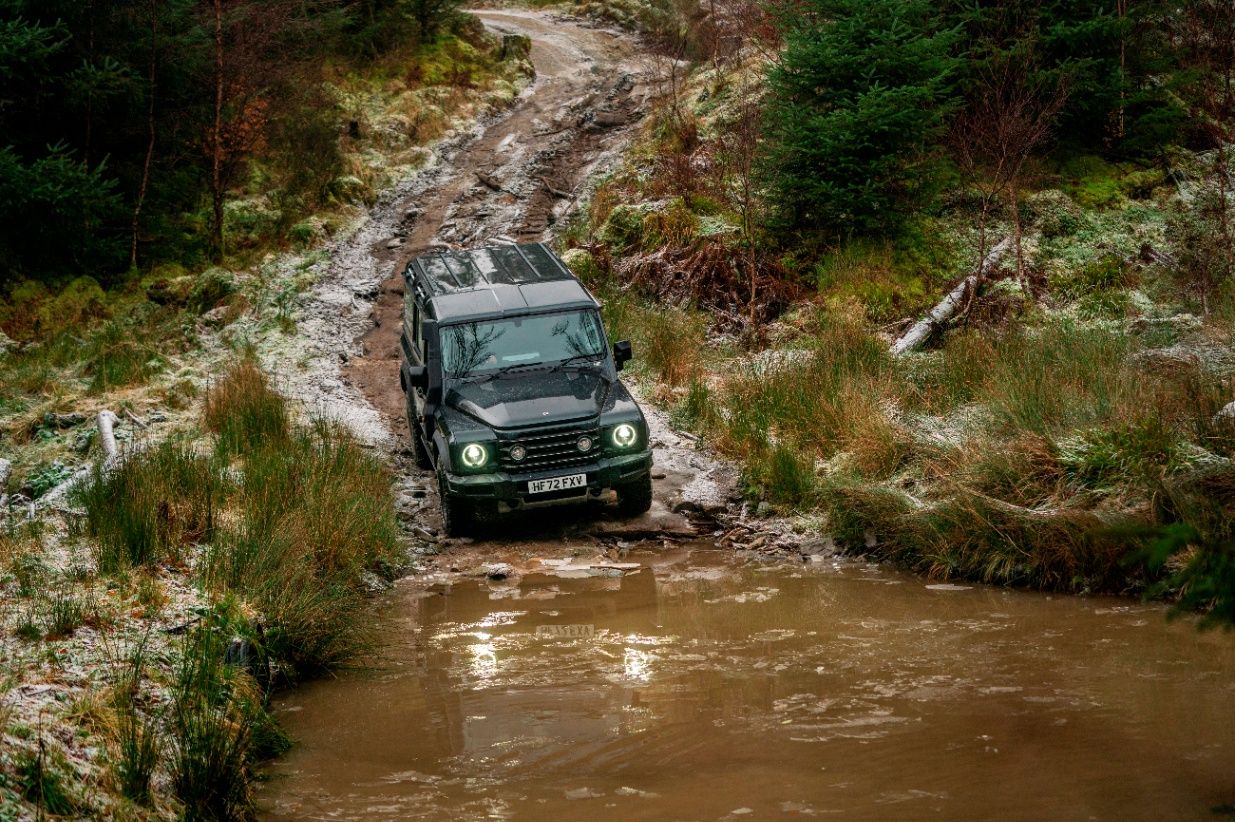
Even the Americans were impressed, with Dan Neil writing in the Wall Street Journal gushing:
Off tarmac, the Grenadier is a bonny, boxy billy goat. With the transfer case in low range, with axles locked, it can crawl up, over and down damn near anything at an ant’s pace, just over 1 mph. The short, skid plate-protected overhangs and close-coupled wheelbase give Grenadier superheroic powers of up-and-over.
How does the Grenadier fare on the road?
Where some modern SUVs make compromises on off-road performance in order to optimise the on-tarmac driving experience, the Grenadier's design and engineering team have taken the opposite approach. So how does the vehicle get on when the going gets easy? One could be forgiven for imagining that it might be a rolling, yawing, rattling, snail-paced lummox, but is it?
Well, not according to Daniel Gardner on the Wheels Australia YouTube channel.
"This is a twin ride axel car, just like the Jeep Wrangler or the previous Defender, but it absolutely does not ride like one. That's partly thanks to coil springs all-round, but clearly the INEOS engineering team have put a lot of effort into making sure that this thing rides properly when you get back on the road, and it is absolutely staggering."

Being real for a second, a vehicle that weighs 2.8 tonnes is not going to be the quickest, and the chances are that you're not buying it for its off-the-line acceleration. Nevertheless, the reviewers seem satisfied with the performance. Alistair Charlton, writing for T3.com writes:
The BMW engines can cope well enough though; 282 horsepower and 450 Nm of torque from the petrol, or 245 hp and 550 Nm from the diesel, equates to 0-60 mph times of 8.6 and 9.6 seconds respectively.
Jim Holder of Autocar.co.uk was also pleasantly surprised by the on-road performance of the Grenadier, and goes into a bit more detail:
Given its rudimentary construction, it grips without excessive roll and understeers benignly if you do go in too fast, all the while soaking up whatever road craters have emerged this winter. Don’t read that as a suggestion that there is any depth of dynamic poise – we’re talking a ladder frame and 2.8 tonnes here – but a smooth hurry along an A-road is the sort of challenge that leaves you satisfied that you tried. The depth of sophistication is highlighted in more mundane areas, too, in particular for how little wind noise is whipped off the boxy shape. All you really hear is the transfer box’s constant if distant whine. This is all complemented by the silky smoothness of both of the BMW-sourced six-cylinder engines, one petrol, one diesel. Linked to the eight-speed ZF gearbox, the petrol makes 332lb ft and the diesel 406lb ft. They are a joy, and while common sense is likely to point you at the diesel’s still mildly alarming real-world 22mpg and better low-down pull, both engines deliver lavish, controllable propulsion across the revs. There is, however, something quite alluring about the petrol, providing you can live with 15mpg as an everyday metric.
Are there any criticisms?
So far, so promising. But this is INEOS's first attempt, so there are no doubt those who are asking whether Sir Jim Ratcliffe and his team can deliver. A car reviewer's job is to point out the flaws, so are there any niggles or problems to be aware of?
Nearly every reviewer highlighted the same handful of less-than-perfect aspects. Probably the one that matters the most is the handling and steering. One of the compromises that INEOS have made in order to ensure the best possible off-road performance is employing a recirculating-ball steering system (no, me neither).
Using this system allows for the extreme (9 degrees) front-axle articulation that helps keep all four wheels on the floor on rough terrain. However, it does have its downsides. On T3.com Alistair Charlton's review is typical, when he describes the steering "as slow and a little vague," adding that "The result is a car that requires constant steering correction, which when combined with a noticeable dead spot in the middle and slow response can be disconcerting until you get used to it."

But how much of a problem this is will likely be down to personal taste and what you want out of an off-roader... are you really buying it for its handling and ability to take fast corners? Goodwood.com has worked out who the likely customers are:
The slow, low-geared steering tempers your ambitions on the road but once you settle into it the Grenadier has refinement sufficient that you might feel willing to cruise from London to that remote Scottish estate for a straightforward shooting weekend, and enjoy the fact you could then drive onto the moor without having to swap your kit into the gamekeeper’s smelly old Hilux.
Gary Pusey, writing in Land Rover Monthly, perhaps puts the issue into perspective best when recalling the conversation among motoring journalists on the 'Expedition 1.0' press drive:
The buzz among the scribblers as we gather for dinner is the steering, which many think is too vague on the road. I know what they mean, but as a hardened driver of old Land Rovers I suppose it's something I'm used to. On-road compromise is what you get when you go for off-road perfection.
Two more of the common complaints are specific to the right-hand-drive version. Reviewers highlight that the windscreen wipers don't properly clear the glass of grime. On Auto Express's YouTube review Steve Fowler complains:
"...the wipers make a noise, but they also leave a massive blindspot. As if the problem with A-pillars wasn't bad enough these days, you get a really big blindspot, which isn't great on the road; you're sort of peering around it at roundabouts."
While people appreciate the comfortable Recaro seats and the driving position, also mentioned in many of the reviews I have seen are the ergonomics of the driver's side footwell in the right-hand-drive verison. Jonny Smith again:
Having driven it off road already and now on the road, my left knee sits higher than my right knee, or at least it feels like it because there's a really large intrusion into the trans-tunnel, and I believe that's for the exhaust manifold... I can't get my left foot very comfortable... some of the ergonomics of how you sit and drive it, I think, aren't quite right.
A handful of others also note that this intrusion forces the pedals to be off-centre. Here's Jim Holder writing on autocar.co.uk:
Disguised as the world’s widest footrest it may be, and surely big enough for a pair of size 16s, but as a result, the brake pedal doesn’t start until beyond the centre point of the steering wheel. On first acquaintance, you half- wonder if you need to make use of that dashboard compass to send an expedition out east to discover the accelerator.
One or two reviewers also note that the visibility through the rear window is somewhat reduced by the presence of the spare wheel, and a couple mention that the combination of huge ground clearance and no handle on the drivers's side make it something of a challenge to get in and out of.
What about the Grenadier's looks?
OK, let's address the elephant in the room. Neither Jim Ratcliffe nor the INEOS team deny that the inspiration for the vehicle came from the old Land Rover Defender. However, the reviewers are unanimous that there is more to the design than this. Jim Holder in Autocar.co.uk calls it "in shape as much Mercedes G-Wagen as it is British icon, perhaps even with a hint of Land Cruiser at the rear."
Also meeting with near-universal approval is the blend of digital and analogue in the cabin. Goodwood.com again:
On the inside Ineos has taken full advantage of not being chained to legacy design and delivered an interior that is both characterful and usable in equal measure. Chunky, rubberised switchgear configured like the control panel for some sort of heavy industrial or agricultural implement shouts a deliberate focus on functionality, major controls grouped together logically with off-road selectors and switches for the pre-wired accessory outputs in an aircraft style roof panel. Given the controls all look the same it takes some muscle memory to remember which is which, but that will likely come with more time at the wheel. There are some nice, playful touches as well, like a ‘Toot’ button with a less aggressive secondary horn to alert horse riders and cyclists (inspired by Ineos’s sponsorship of the latter) and port and starboard flashes to the panels in a reference to its sailing connections.
The reviewers are also complimentary about the build quality. Daniel Gardner comments:
The quality of the interior is also really surprising. It wouldn't be the first time for a fledgeling startup car company to release a product to market and for it to have some serious shortcomings in build quality. But I've spent two days in this car now, on and off road, and there isn't a single squeak or rattle from its interior. The fit out is amazing, the quality of the materials is surprisingly good... This car gets a straight 10 for build quality.
Goodwood.com concur, saying: "Fit and finish are also impressively slick, perhaps vindicating Ineos’s decision to take on an established factory from Mercedes and, with it, facilities and a workforce equipped to do the job properly."

So.. should I buy one?
The reviewers generally conclude that while the vehicle is imperfect, whether these imperfections turn you off is going to come down to what you're looking for, and what matters to you.
Andrew English's Telegraph review is one of the harshest, giving the Grenadier a 3/5 star rating. For him, while the Grenadier is "an impressive debut" he can't forgive the "silly errors." Others, meanwhile, are more forgiving, like Autocar.co.uk's Jim Holder, who says:
Ineos set out to build an imperious off-roader with character, and for the most part it has done just that. That in itself is an enormous triumph. Today’s Grenadier is certainly good enough to stand on its own merits and sit on any shortlist against even the best of its competition. Given the timescales and challenges, it’s an incredible achievement.
Another of the harshest reviewers, Steve Fowler on the Auto Express YouTube concludes his video review thus: "It is full of charm, but quite often charm comes from flaws. It's not perfect... Do I like it? Yeah, I really do! "
For Jonny Smith of The Late Brake Show, the appeal of the Grenadier is not sweeping lines, luxury and high-tech gizmos, but quite the opposite:
I love the concept of this, not being a looker, but being born fit for purpose, and giving the 'vees' to built in obsolescense, and amen to that. I'd love to buy a car that I know is going to last 15, 20 years and go into the Bush and come back, like so many Land Rovers don't.
Jason Barlow on topgear.com, is another fan:
The Grenadier is exceptionally well-engineered and does exactly what it sets out to do: go places most cars can’t without falling apart, and do it with some imagination and a dose of British idiosyncrasy. It’s also more accomplished on-road than its rivals, and almost as good as the Mercedes G-Wagen, a vehicle made by the company that invented the car in the first place. Only rather less expensive.
But perhaps it makes sense to conclude with the views of 4x4 expert, Alan Kidd for 4x4 magazine.
It’s as pleasing to spend the day in as any premium SUV – but when you point it at the terrain, it’s a fully fledged superhero. Like the old Defender, it has its foibles – we’re very much looking forward to spending enough time in one to see if we can get used to its steering, for instance – but over the piece, as we sat aboard the Grenadier during Expedition 1.0, one conclusion kept on forming itself in our heads. Which is that much as we love the new Defender, this is the vehicle it should have been. INEOS has done it.
Think the Grenadier might be for you? Configure your perfect off-roader here, or book a test drive with your local INEOS Grenadier dealership.
Comments
Loading comments…
Post a comment
to post a comment.