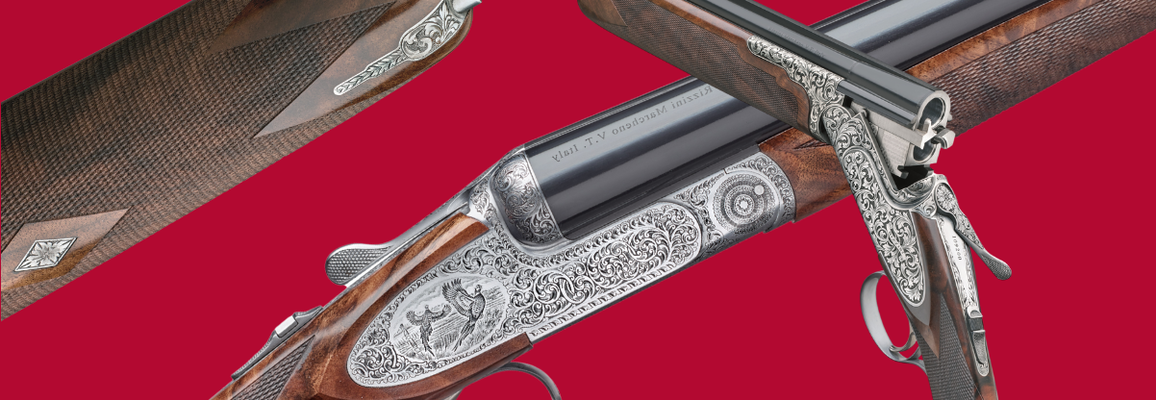
A fine shotgun is the ultimate gentleman’s accessory and there is no doubt about it, the Italians have style. They set global trends whether in gunmaking, cars or coffee, and the rest of the world eyes them with a mixture of envy and awe. London gunmaking, in contrast, has a tradition of classical uniformity – the kind designed not to make the Brigadier’s monocle pop out at elevenses.
No one strays too far out of the lane of fashion for fear of being dropped from the team of guns next time. But none of that seems to matter to the Italians – in gentleman’s fashion they even have a word for it – sprezzatura. Loosely translated, it is the art of effortless grace – making the complex task of shooting well look easy.

In 1966 Battista Rizzini took the Italian cultural desire to elevate function into beauty and added precision in gunmaking. But in contrast to Enzo Ferrari’s iron grip at his eponymous carmaker, Rizzini was looking at increasing production, not restricting it to an exclusive club of those who could afford it.
The Rizzini custom shop will build on request whatever your imagination can conjure, but the real attraction is the company’s willingness to make regular gun buyers feel special. If you want a 30” single-trigger 28-bore side by side for game shooting – you can have it. If you prefer a double-trigger multichoke – you can have it. If you prefer a straight grip for that double trigger, it is available at no extra cost.

They are not looking down their noses at you wondering if you are just kicking the tyres; in fact, if you want to fly out to northern Italy and see the guns being made and choose the wood for your gun you can again, at no extra cost.
Rizzini also has the style to suit the occasion. The business-like demeanour of the competition guns is less about the distraction of embellishment and more about the podium. But if you have the confidence in your own ability, then the S2000 Sporting may be for you. The engraved lock plates draw on centuries of the engraver’s art.

This art form has been fostered through the centuries in small family workshops where designs were handed down over generations, creating idiosyncratic styles. One of the reasons these styles have now become known the world over is that they didn’t happen overnight. They are rooted in the long heritage of Italian engraving.
Over the last thousand years, the embellishment of metalwork was financially supported by the economic superpowers of their day – the Catholic Church and the duchies and maritime empires of the Italian city-states, who between them fostered the Renaissance that helped bring mankind out of the Dark Ages (although Johannes Gutenberg might argue that his printing press did much of the heavy lifting, even if the Chinese had got there before him).

We have always scratched motifs into hunting tools and weapons of war to celebrate epic hunts and great victories in battle. During the Renaissance, the Italians took the idea of personalisation and celebration and raised it to high art.
Of course, these days much of the labour of removing metal is done by computer numerically controlled (CNC) machines, but that ability is based on the designs created by the masters of the art, and the speed at which Rizzini can now satisfy the market for fine-looking, good-quality firearms has essentially democratised the process of owning beautiful guns.

The rise of Italian gunmaking was something of a reaction against the exclusivity of the London club of gunmaking with its formality, its rules and an often po-faced attitude to anything that looked fresh. New ideas were regarded as potentially threatening to an old-world order that they failed to notice had coughed violently during the Great War and failed to get out of its chair in the post-war decline.
Whilst British gun manufacturing struggled for breath from a failure to modernise during the 1960s and the industrial action of the 1970s, a better-looking Italian cousin sauntered into view with a sharp suit and a sharper eye for detail.

With an elegant simplicity and the willingness to innovate, Rizzini and others brought the idea of beauty as a necessity, not just a luxury, and a jaded British public was willing and ready to buy in. The application of sprezzatura to gunmaking tore the fabric of what we thought we knew about the processes employed in making good-quality guns.
Even now, more than 50 years after Battista Rizzini began the process of replicable precision in gunmaking, many gunmakers outside Italy are running to catch up. It is perhaps telling that still today, if you go round some of the factories of the best names in British gunmaking, you will find second-hand machines in daily use that were built in Italy.

If you’d like to know more about Rizzini’s range - from custom commissions to off-the-shelf elegance - visit Rizzini and explore the craftsmanship for yourself.

Comments
Loading comments…
Post a comment
to post a comment.