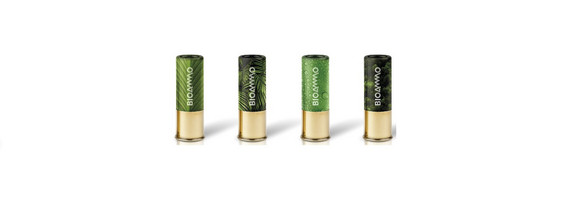
Since the joint announcement from the shooting organisations that they would be encouraging a phasing out of both lead and plastic wads in game cartridges there has been an upsurge in interest in environmentally-friendly wads and loads. But one company has gone one step further, creating a cartridge where all the non-metal components are biodegradable.
Eco-friendly shotgun cartridges
BioAmmo is a Spanish company which has spent years developing a 0% plastic cartridge for both game and clay shooting. The cartridges are made from a patented 100% vegetable biopolymer material that is not just biodegradable but, more importantly, bio-compostable too. This means that they leave no toxic residue what-so-ever, something that will come as a relief to anyone whose ejectors are a bit vigorous - you can miss an empty and not feel too guilty about polluting the environment.

The anatomy of a BioAmmo shotgun cartridge
After a while, both the casing and the wad will have broken down into no more than CO2, water, some mineral salts and biomass, thanks to the industrious work of fungi, algae and other microorganisms. Wildfowlers will also be pleased to know that the empty shells sink, and then gradually biodegrade in the silt, so again, its not the end of the world if you miss one. However, if you collect up your empties like a good, conscientious gun, then you can take them home and chuck them on the compost heap.

People using semi-autos sometimes find it hard to locate spent cases
100% plastic-free cartridges
I spoke to Nick Levett-Scrivener, from Shooting Star, the UK distributor for Bio-Ammo, to get some more info. He was particularly keen to stress that the product is 100% plastic-free, and that “unlike, perhaps, some other products” the material will not break down into microplastics. I was interested to get some info on how long it takes for the cases and wads to break down. “We’ve got some buried in a couple of plant pots by the back door,” he told me, “as a bit of an experiment. But it does take some time to degrade and it depends on the conditions. If you leave it in a field where it's just on the surface, it could take 18 months to 2 years, but if you stick it on a compost heap it could be as little as 8 weeks before it's gone.

The wad/shotcups are brown, meaning they won't present an eyesore while they decompose
The cartridges are available in both lead and high performance steel, in 70mm cases. The lead cartridges come in 28, 30, 32, 34 and 36g, with shot sizes 4 - 10. In the steel cartridges there’s slightly less choice, with 28, 30, 32 and 34g loads, and shot sizes 3,4,5 and 7. Both lead and steel variants use the same wad-cup system. Currently they are only available for 12 bores, but 20s will be available ahead of next season.
But, of course, the big question on your lips, dear reader, is “how do they perform?” Nick is a fan: “I’ve shot them in anger in Spain and the UK, and watched others using them - they’re good cartridges that will stand up next to anything else on the market.” In a recent test carried out by Fieldsports Channel, the cartridges performed impressively on ballistic gel.

When discussing steel shot, it is never long before someone says that steel simply doesn’t have the same ‘knock down power’ as lead. Nick disagrees with this. “If you use a 32g no.3 in steel, you will kill anything that you want to kill within 65 yards - they’ll do the same as a no.5 lead cartridge.”
Eco-cartridges for older guns
Another question that frequently rears its head is around older guns. As I have mentioned in other articles, my situation is a particularly interesting one. I shoot with a (possibly) 1970s AYA side-by-sde, without the fleur de lis stamp that indicates that it is proofed for high performance steel cartridges, and with 65mm chambers. The current crop of eco-cartridges don’t cater for the likes of me yet, but I was gratified to hear that BioAmmo are planning on producing 65mm cases, which is music to my ears.
Even better, perhaps, is the fact that there is also a plan to load BioAmmo with a new alloy shot that will be called ‘Zero’. The same material, a blend of zinc, bismuth, aluminium, and tin, is currently used in certain Joker cartridges, which Shooting Star also import. “I’ve used it, and it is good,” says Nick, “In a 70mm case you can get around 26g, so in a 65mm case you’d get around 25g of shot but because it is not heavy you’d have more pellets, so it would be fine for all reasonable gamebirds and it would be fine with your old side-by-side."
The advantage of this “Zero” shot is that you can use it in any gun, but also, it's not that expensive. The reason I say that this is potentially even better, from my perspective, is that my gun has one barrel with full choke, meaning without drastic measures, it won’t even take standard steel. Perhaps this new material is the answer? These cartridges will be available “relatively soon”, with test samples arriving in the UK in the next month, so I await further info with interest!

BioAmmo say that they will have solutions for users of older shotguns
Another criticism that is levelled at this new generation of cartridges is the price, but Nick makes a valid point that the “cost per bang” is still quite small. “Cartridges are priced in thousands, but used in ones,” he notes. “If you look at it ‘per bang’ it makes more sense - and of course the alternative to not taking up these products is potentially no more bang at all!” Using Nick’s price-per-bang system, most fibre wad lead cartridges fall in the 28-35p bracket, while BioAmmo’s steel shot shells are around 38p per bang, and the lead load 40p. Looked at like this, the cost of the cartridge is a fraction of the cost of the bird at which it is being fired. The price for the Zero, mentioned above, is somewhere between bismuth and lead - it works out at about half the price of bismuth.
Speaking for myself, I find it encouraging to see the cartridge industry - both established and new to the market (like BioAmmo) - embracing change and developing new products to meet the growing demand for environmentally friendly cartridges, and especially encouraging to see a company going the extra mile to ensure that there are not only 100% eco-friendly options, but also exploring options for people with guns of all types and vintages. I look forward to trying some of the 65mm cartridges through my AYA.

Comments
Loading comments…
Post a comment
to post a comment.