
According to the Food Standards Agency “Consuming lead is harmful, health experts advise to minimise lead consumption as much as possible. Anyone who eats lead-shot game should be aware of the risks posed by consuming large amounts of lead, especially children and pregnant women… Exposure to lead can harm the developing brain and nervous system.”
Given my kids’ disadvantageous parentage, I have, thus far, shied away from further impairing their life chances by feeding them too much lead-shot game. However, I’m loathe to give up my much loved AYA no.2, which for reasons best-known to the previous owner, is choked ¼ and full, making it unsuitable even for ‘Standard’ steel loads. Not being a millionaire, alternatives such as Bismuth haven’t seemed a practical solution.
The Holy Grail of non-lead cartridges
Nevertheless, I am keen that eating game should be ‘normal’ for my twins, and now that they are 3 ½, it seems the right time to begin introducing them to the world of wild food - a little late, even. Not wishing to start mucking about with my chokes or to buy a new gun, I’ve been waiting patiently for the cartridge manufacturers to produce a game cartridge that meets the following criteria:
- 65-67mm case
- Non-plastic wad
- Non-lead, non-steel load
- Sensible price
This is, as far as I am concerned, the ‘Holy Grail’ of non-lead loads. Imagine my delight to learn, when chatting to Alex and Nick Levett-Scrivener of cartridge distributors Shooting Star at the Game Fair, that just such a cartridge is now available in the UK, in the form of BioAmmo Blues, now loaded in 67mm cases.

Sustainable shotgun cartridges
In case you haven’t come across them before, BioAmmo are a Spanish company who specialise in making sustainable ammunition. The cases and wads, which are made from vegetable-based biopolymers, are fully compostable and environmentally friendly.
In the case of Blues, the cartridges are loaded with shot made from an alloy of aluminium, zinc, tin and bismuth, making the shot about 25% less dense than lead, but denser than steel, as well as soft enough that it can be used in any gun with any choke. The alloy is also less brittle than bismuth.
Importantly, when it comes to price, they are far closer to the cost of lead and steel loads than they are to the cost of bismuth.
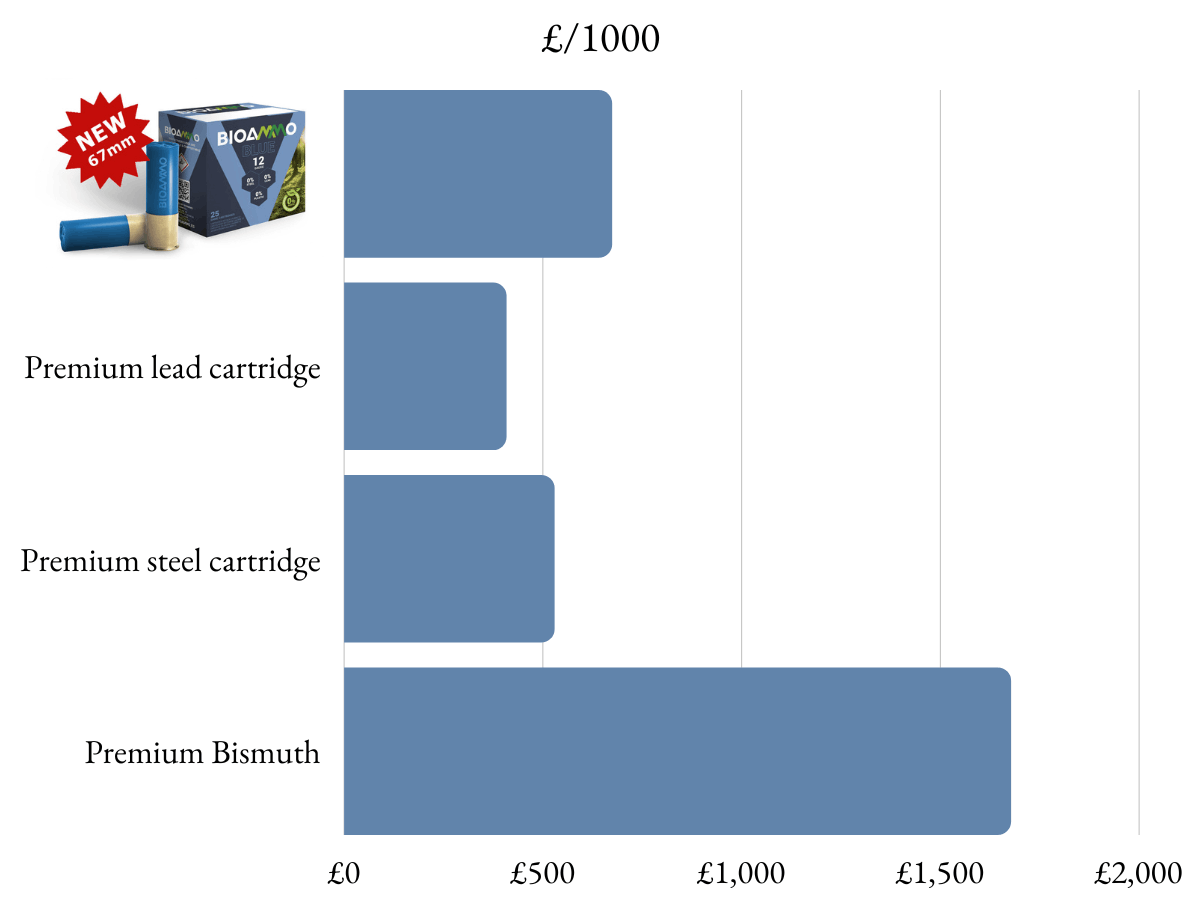
The Blues have been around for some time, but until recently have only been available in 70mm cases, making them unsuitable for older guns with shorter chambers, but now that they have become available in 67mm chambers, I was keen to give them a go.
BioAmmo Blues vs woodies
Conveniently, here on the farm there’s plenty of barley stubble at the moment, and a corresponding number of pigeons, so I took the opportunity of a dry day to head out for a couple of hours with my AYA and a box of BioAmmo Blues with three chief ambitions:
First, to put the wind up the grey marauders and dent the population a bit before drilling begins. Second, to find out if the Blues are a decent option for me ahead of the game season. And finally, to bag a bird or two to whack on the barbecue and give my twins their first taste of wild game.
Winging it
Now, I have to say at this stage that unlike some pigeon shots, I have to take my opportunities when I can get them, so what with torrential rain, childcare and other commitments, days of recon are a luxury I don’t have.
Instead I must rely on the knowledge of the flightlines gleaned over 30 years of living here, and my natural instincts. Or, to put it another way, I was going in blind. I also had a small window of opportunity - a couple of hours tops, to execute my plan.
After a couple of false starts, I found a patch of the farm with a few pigeons bumbling about. There were no great feeding flocks, and no obvious flightlines in play. However, the field in question is bordered on one side by a railway embankment.
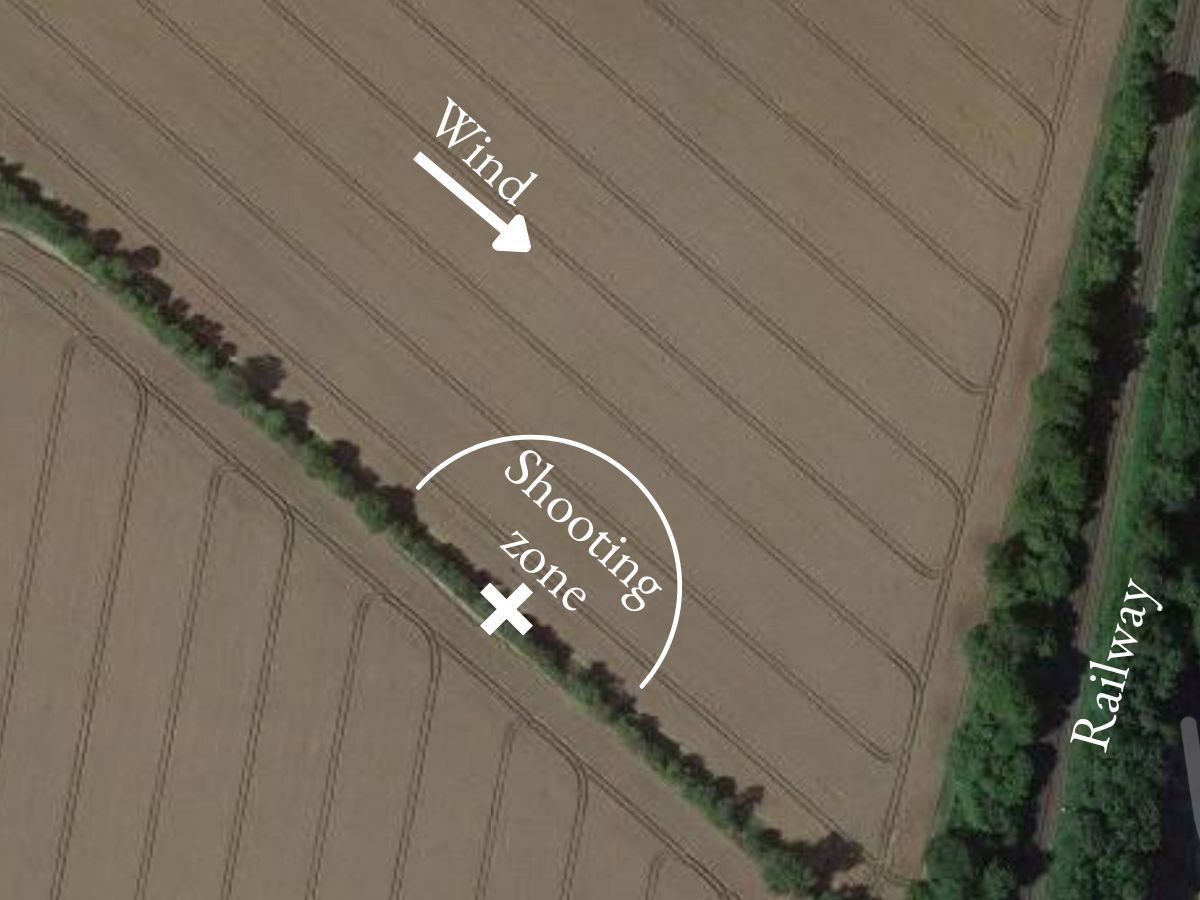
This edge of the field is met at roughly right angles by a thin belt of trees, and the stiffish breeze was blowing more or less parallel with this belt. The tree-lined embankment is popular among the pigeons, so I positioned myself in the belt, so distance from the embankment, hopeful of intercepting any birds travelling to or from the railway.
To my enormous surprise, the plan worked. After about 25 minutes or so, a pair of woodies whistled downwind. Not having a hide, and perhaps being over-eager, I spooked them and could only send them on their way with a hurried two-barrelled salute.
Shooting BioAmmo Blue for the first time
I had heard on the grapevine that Blues pack a bit of a punch on the shoulder. I was shooting 25g no.6 shot. I am happy to report that in my relatively lightweight AYA, I wouldn’t say that those first shots felt unduly heavy.
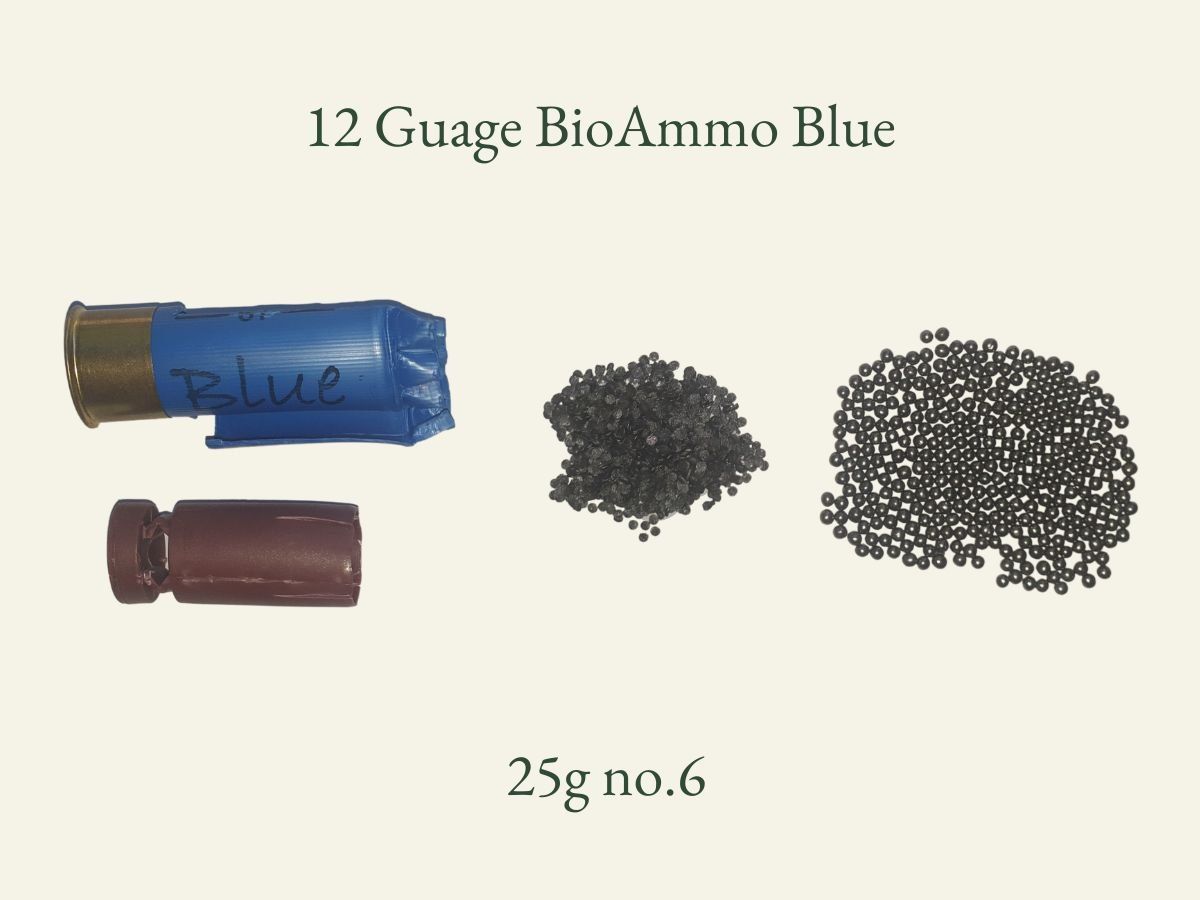
(By the way, if you’re thinking that 25g sounds a little on the light side, I cut one open and reckon there’s around 330 individual no.6 shot in each - somewhat more than the 270 found in a 28g 6 in lead shot.)
My next opportunity was a crossing bird at about 35 yards. Using lead I’d back myself to hit this sort of bird about one in three times. In this instance, I missed it clean. I put it down to a lack of practice. Next came a pair zooming away from me as they scudded in from behind me. I missed beneath. Thus far all I had proven was what Diggory Haddoke wrote in his review of the Blues: “a bird missed with BioAmmo remains just as healthy as a bird missed with lead!”
My time was running out, as was my confidence. With just ten minutes left in my shooting window, a fast-moving train caused about half a dozen pigeons to spook from their posts on the embankment. I watched them circle and was disappointed when they seemed to opt for a different path, circling behind the belt of trees to which I had my back.
However, just as I was untensing, I saw that a pair had broken off and had crossed the trees some hundred yards above me. They turned on the wind and began heading back to the railway. As they crossed in front, about 20 yards up and 30 yards out, I mounted the gun and swung through, squeezing off my first shot as the lead bird was directly in front of me. The head went back and the bird hit the floor dead. The second bird darted away and up, my reactions were no match for its agility and my second shot missed low and wide.
As with all non-lead cartridges, there were questions in my mind regarding the knock-down power of the Blues. The key to knock-down power is a function of the speed at which the projectiles are travelling, and therefore the amount of energy transferred into the bird.

Power at the point of impact
However, Nick Levett-Scrivener explained to me at the Game Fair that muzzle velocity stats of non-lead cartridges, measured 2.5m from the muzzle, can be misleading. “The key number that you need to look at,” said Nick, “is the V2 velocity, which is measured at 25m, because it as at this sort of distance that we are shooting, and it gives a far better picture of how a cartridge will perform.” The 25g 6 Blues have a velocity of 251m/s measured at 25m, not far off the speed of a premium lead cartridge.
And with that I begrudgingly had to end my highly unscientific fieldtest on the Blues. It was, however, enough to give me confidence that on the traditionally presented partridges that are my shooting bread-and-butter, I have a non-lead load I can use in my gun, and I don’t have to get a gunsmith involved. In terms of equivalence, a shot size 6 in Blues is akin to a no.7 in lead, so I’ll probably move to a 5 for the early season partridge, and a 4 for later season pheasants.
Oh, and the pigeon breasts were barbecued with a little salt, pepper and olive oil, and were a smash hit with the kids.
Comments
Loading comments…
Post a comment
to post a comment.